Porthos: Decarbonizing Europe's largest industrial port
The Porthos project is a large-scale initiative aiming at significantly reducing the environmental footprint of Europe's largest industrial port, Rotterdam in the Netherlands. Air Liquide is playing a leading role in the development of carbon capture, enabling the production of hydrogen with a significantly lower carbon footprint. Objective: to decarbonize this port area without deindustrializing it, thanks to an ambitious Carbon Capture and Sequestration (CCS) solution.
The Porthos project in brief
-
Since 2006, Air Liquide has been developing patented technologies for CO₂ capture
-
Air Liquide commissioned the first carbon capture system, Cryocap™, at the largest steam methane reforming hydrogen production unit operated by the Group
-
Start of construction on the Porthos project
-
The carbon capture unit is expected to be commissioned

Decarbonizing Rotterdam
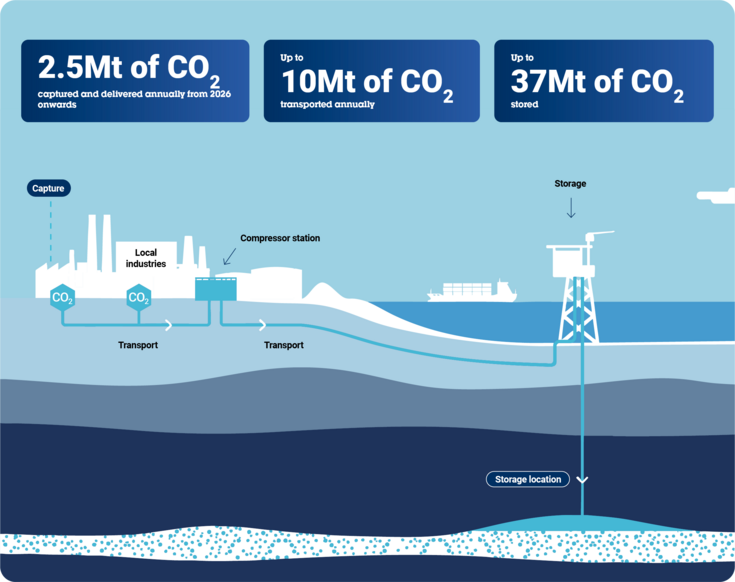
The Porthos project is part of an effort to decarbonize the Port of Rotterdam, which accounts for approximately 15% of the Netherlands' CO₂ emissions1. The project aims to build the infrastructure needed to collect and transport the CO₂ emitted by several industrial sites in the port area. This CO₂ will then be permanently sequestered in depleted gas fields beneath the North Sea.
This infrastructure includes:
- a CO₂ pipeline through the Rotterdam port area
- a compression terminal
- a platform in the North Sea, at the level of the sequestration reservoir

The new Porthos infrastructure will enable the transport and sequestration of 2.5 million tonnes of CO₂ per year. Over 15 years, 37 million tonnes of CO₂ will be safely and permanently sequestered 3,000 meters beneath the North Sea. This represents around 10% of the CO₂ emitted by industrial activities in Rotterdam.
Construction began in early 2024 and is scheduled to be operational from 2026. Air Liquide will be one of the first four customers, along with other companies in the Rotterdam port area, including Shell, Exxon and Air Products. The Group is building a Cryocap™ unit at its Rozenburg site in the port of Rotterdam. The aim is capturing CO₂ from its hydrogen production plant by reforming natural gas. The captured CO₂ will then be transported through the Porthos infrastructure, and Air Liquide will be able to supply its customers with low-carbon hydrogen under long-term contracts.
-
2.5 Mt of CO₂ captured and delivered each year
-
Up to 10 Mt of CO₂ transported each year
-
Up to 37 Mt of CO₂ sequestered
Porthos was made possible with a grant from the Connecting Europe Facility (CEF)². A total of 1.3 billion euros has been invested in this public-private initiative by the Port of Rotterdam Authority, Gasunie3 and Energie Beheer Nederland (EBN)4. Air Liquide is a key player in this partnership, thanks to its proprietary Cryocap™ technology. This represents a fast and effective solution for decarbonizing high-emission industries, in particular for certain sectors that are difficult to decarbonize, such as cement, steel and chemicals.
A technological breakthrough
Porthos represents a major technological breakthrough for Air Liquide, as it will be the first large-scale CCS project in which the Group is involved to capture and sequester large volumes of CO₂ in offshore carbon sinks.
This project is just the beginning. The pipeline has been designed to transport up to 10 million tonnes of CO₂ per year. The plan is to build an industrial CCS network linking future projects throughout Northern Europe.
To develop the CCS value chain, Air Liquide is sharing its CO₂-related expertise and technologies with partners specializing in carbon transport and sequestration. The Group's objective: to accelerate the development of CCS on a global scale.

“It’s critical to develop an ecosystem approach with strong private and public partnerships to decarbonize key industrial basins through large-scale CCS programs.
”
Tom Eikmans
Senior Business Owner of the Porthos project at Air Liquide
The technology used: Cryocap™ H₂
The Cryocap™ technology relies on a unique process developed by Air Liquide. It consists of capturing the CO₂ emitted during hydrogen production using a cryogenic process, thereby allowing it to be liquefied and purified. This CO₂ can then be supplied for use in the agri-food sector or by water treatment players.
Find out more about this technology in this video:
Discover more
-
In Rotterdam, a CO₂ Transportation and Storage Project to decarbonize European industryThe Porthos project designed for CO₂ reduction in the largest industrial port in Europe and to set a standard for other industrial hubs to follow. Its goal: substantially reduce the site’s CO₂ emissions thanks to CCS.Read more
-
Capturing CO₂ to decarbonize Rotterdam’s industrial basinAir Liquide is one of the four launching customers of the Porthos project, an infrastructure initiative to capture and store the CO₂ emissions of Europe’s largest industrial port. The goal: substantially reduce the environmental footprint of the Port of Rotterdam in the Netherlands thanks to an ambitious carbon capture and sequestration (CCS) solution.Read more
-
Air Liquide to build a world-scale CO₂ capture unit to contribute to Rotterdam’s industrial basin decarbonizationAir Liquide to build a world-scale CO₂ capture unit to contribute to Rotterdam’s industrial basin decarbonizationRead more


1. Port of Rotterdam - https://www.portofrotterdam.com/en/news-and-press-releases/10-decrease-port-rotterdam-co2-emissions-2023
2. Connecting Europe Facility (CEF) is a funding program for projects in the fields of energy, transportation, and digital infrastructure.
3. The public company responsible for transporting natural gas in the Netherlands
4. A gas group owned by the Dutch states.