Hydrogen in South Korea: Air Liquide accelerates large scale mobility
Published on March 11, 2026
4 minutes

South Korea is now establishing itself as one of the world leaders in energy transition. With a national target of reducing greenhouse gases by between 53% and 61% by 2035, the country is focusing, notably on accelerating hydrogen mobility. As a strategic partner in this sector, Air Liquide is deploying its expertise across the entire value chain, from production to distribution, with a clear priority: heavy and commercial transport.
Key takeaways
- Acceleration of heavy and commercial mobility: To achieve its climate goals, South Korea plans to deploy several thousand hydrogen-powered buses. Fuel cells are the preferred choice for heavy transport because they offer better operational efficiency and higher payload capacity than electric batteries.
- Expansion of distribution infrastructure: Air Liquide supports this rollout through consortiums to ensure a smooth, safe, and competitively priced supply for commercial fleets.
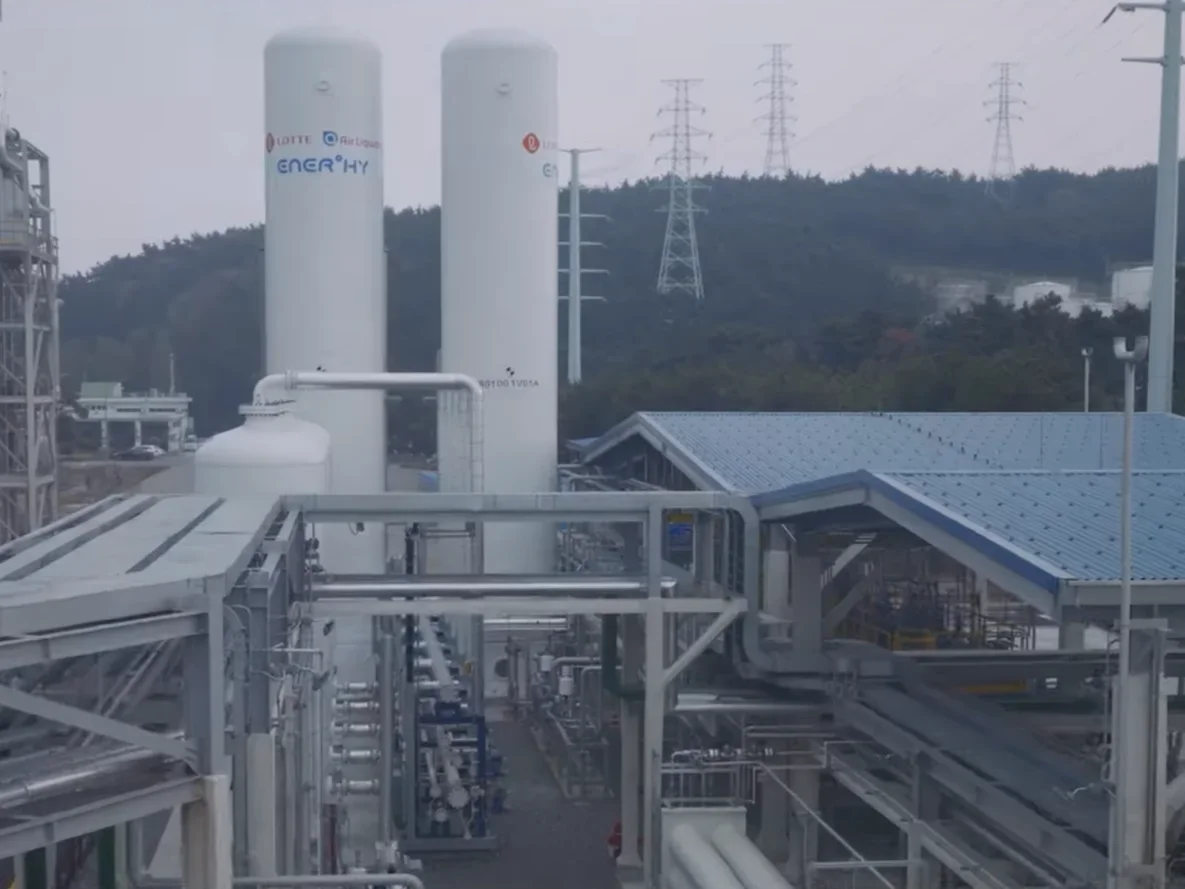
- Strategic logistics network in Daesan: Scheduled to open in late 2025, the Lotte-Air Liquide Ener'Hy packaging center is the largest site in Korea with a capacity of 17 tons of hydrogen per day. This hub combines Lotte Chemical's stable supply with Air Liquide's technological expertise to provide a sustainable supply of hydrogen to the Seoul metropolitan area.
Heavy-duty mobility: driving carbon neutrality

The commercial sector - buses and trucks - is crucial for the decarbonization of mobility. For freight operators, fuel cells (FCEVs) are the obvious choice over battery electric vehicles for reasons of operational efficiency.
"Hydrogen trucks weigh much less than battery trucks, allowing us to carry full loads and operate for longer periods of time."
Joon-Seok Oh, CEO of SeoAn Energy.
Public buses and coaches, which are key players in this transition, are also being adopted quickly. The government's strategy calls for the deployment of several thousand hydrogen-powered buses in the coming years. For the transport company Kang Nam Tour, the change is already palpable: "Hydrogen buses produce almost no noise and our drivers report that they are much more comfortable to drive," says its CEO, Hae-jin Lee.
State-of-the-art infrastructure for reliable hydrogen supply

To support this growing fleet, Air Liquide is actively involved in the HyNet1 and KOHYGEN² consortiums. HyNet operates close to 70 stations (24% market share in Korea) and can count on the support of its main shareholder, Hyundai Motor Group.
"HyNet's mission is clear: lay the foundations for a true hydrogen society in Korea."
Sung-ho Song, CEO of HyNet

KOHYGEN focuses on high-capacity stations for buses and trucks, using doubled equipment to avoid any downtime.
"Our goal is to provide hydrogen in a stable and safe manner to heavy-duty fleets. We contribute to carbon neutrality by supplying hydrogen in the most efficient way and at the most appropriate price for commercial operators."
Kyoung-sil Lee, CEO of KOHYGEN
The two initiatives share a common objective: to transition to high-capacity infrastructure to ensure reliable and fast service.
Daesan: Korea's strategic hub for hydrogen logistics
Inaugurated at the end of 2025, the Lotte-Air Liquide Ener'Hy filling center in Daesan is a key part of the national infrastructure. It is the largest site of its kind in Korea, capable of packaging 17 tons of hydrogen per day, which is enough to supply the Seoul metropolitan area.
As explained by Somie Kim, former CEO of Lotte-Air Liquide Ener'Hy: "Ener'Hy's core mission is to build a safe and efficient hydrogen supply chain and expand the domestic hydrogen mobility market in Korea. By combining Lotte Chemical's capacity to provide a stable, large-scale supply of this molecule with Air Liquide's global expertise in operational safety and efficiency, our goal is to establish a sustainable and competitive hydrogen energy supply chain."
Towards hydrogen mobility without borders
Thanks to its strategic partnerships with leaders such as Hyundai and Lotte, Air Liquide is not just supplying a molecule; the Group is building the infrastructure for a cleaner, more sustainable future for South Korea and, tomorrow, for other regions of the world.
2. Korea Hydrogen Green Energy Network
-
53 to 61% South Korea's greenhouse gas reduction target by 2035
-
17 tons of hydrogen per day delivered by the Lotte-Air Liquide Ener'Hy filling center in Daesan
-
Lotte - Air Liquide Ener’Hy, powering hydrogen mobility
-
Driving the hydrogen transition for Korean transport