Our innovation approach
Since its beginning, Air Liquide has made innovation the driving force of its strategy by focusing on major societal trends and our markets of the future: the energy transition, the evolution of healthcare and industry and the development of deeptech.
-
€309 M of innovation expenses in 2024
-
350 innovation partnerships with academics, industrial partners and start-ups
-
More than 3,000 employees work in entities dedicated to innovation
Innovation for the energy transition
Our diversity of technologies and solutions in energy transition and environmental protection, reinforced by digital technologies and a structured open ecosystem, enables our innovation teams to contribute to the Group’s sustainable growth and achieve our objective of carbon neutrality by 2050.
In 2023, Air Liquide devoted 100 million euros of innovation spending to the energy transition, particularly for the development of low-carbon hydrogen and biomethane.
About €8 billion will be invested by 2035 in the low-carbon hydrogen value chain.
-
Hydrogen, a new era for aviationAir Liquide is using its technical and industrial expertise in hydrogen to help decarbonize aviation from the ground to the air
-
Naturally gas!Biomethane is an upgraded form of biogas which can be used to fuel trucks, fed into the grid or used for industrial applications in place of fossil-based natural gas
-
Hydrogen and biomethane, the mobility revolutionHydrogen has a key role to play in the energy mix of the future and is, along with biomethane, at the heart of the clean transport revolution.


Innovation in healthcare
Air Liquide is one of the world leaders in the constantly evolving healthcare sector. It is committed, alongside patients, medical professionals and hospitals, to contributing to making the healthcare system more efficient, particularly through digital technology. Air Liquide, a pioneer in remote medical monitoring, is deploying digital solutions to support patients suffering from chronic diseases from their homes. These solutions, which are based on the analysis of data from connected equipment and on individualized support provided by nurses, improve the therapeutic follow-up of patients and contribute to improving their quality of life. Our teams are constantly exploring the potential of our compounds to find new therapeutic indications. They contribute to simplifying the practice of healthcare professionals through digital technology while personalising our support by combining patient knowledge and data analysis.
-
Towards a new approach to value-based healthcareAir Liquide, in partnership with healthcare professionals, is coordinating an approach which favors personalized support programs for patients in their homes.
-
Knowledge sharing for better care of chronic patientsAntonio is a nurse and Laurenţiu a physiotherapist, they discuss their daily job and their relationship with patients.


Innovation for tech and deep tech
Air Liquide is a major player in deep tech, offering, through its Engineering & Technologies activity, innovative solutions to its customers in the space, aerospace and extreme cryogenics sectors for scientific research or quantum computing. The Group recently inaugurated the Campus Technologies Grenoble, dedicated to the design and manufacture of new technologies for the deep tech and energy transition markets (hydrogen and biomethane). At the same time, it supports a number of deep tech start-ups via its Accelair accelerator, located on the Paris Innovation Campus.
-
Collective intelligence for deep tech solutionsAir Liquide is one of the companies developing deep tech solutions
-
In the race for innovation: electronics and deep techAir Liquide picked up the pace to meet accelerated demand for digital technology, energy transition and scientific research.
-
How 5G technology is as simple as it is revolutionaryAutomated cars, intelligent production lines organising, and remote medicine: these are just some of the applications for 5G mobile broadband


“Our innovation focuses on energy transition, digital, data and AI to offer sustainable solutions to our customers and patients.
”
Armelle Levieux
Member of the Executive Committee, Vice President of Innovation, overseeing the Hydrogen Energy and Electronics activities
-
40 startups accelerated by ALIAD, the Group's venture capital investor
-
70% of R&D projects dedicated to the energy transition
-
3.5 billion data points collected every day
-
500+ use cases, products and programs using data and artificial intelligence
Science and digital, at the heart of all our innovations

A unique scientific expertise
Thanks to its strong expertise in Essential Small Molecules and its knowledge of data science, R&D has a wide range of skills in materials science, process engineering, life science, chemistry, combustion, cryogenics and analytical science that enable Air Liquide to continuously develop new applications for its molecules. With its scientific and industrial partners, R&D is actively working to deepen its knowledge of Essential Small Molecules in order to explore new horizons and thus provide solutions to future challenges in industry and health.
Our 18 Essential Small Molecules are: oxygen (O2), nitrogen (N2), hydrogen (H2), carbon dioxide (CO2), carbon monoxide (CO), methane (CH4), argon (Ar), xenon (Xe), krypton (Kr), neon (Ne), helium (He), nitric oxide (NO), nitrous oxide (N2O), acetylene (C2H2), ozone (O3), water (H2O) and silane (SiH4).
.

Digital in all our offerings
For Air Liquide, leveraging the power of digital means creating more value. Everyday we use data to optimize the management of our industrial assets, develop new offers and services, improve the experience of our customers and teams, and reduce our carbon emissions and those of our customers. The result? More efficiencies, more opportunities for growth, all in a sustainable way.
Every day our teams of developers, designers, data scientists and network architects work with our business teams to imagine, develop, and deploy digital solutions for our customers, patients, employees, while contributing to the Group's efficiency.
Innovation with ecosystems
Our innovation is part of an open, global ecosystem. It is supported by our Innovation Campuses in Europe, the United States and Asia, the Campus Technologies Grenoble in France, and the Digital Factory.
Our innovation teams bring together profiles of different nationalities and skills: scientific and technical profiles in Research & Development, developers, engineers, network architects, designers, data scientists within Digital & IT (including Alizent), technical and commercial profiles for the Engineering & Technologies activity, or for ACCELAIR and ALIAD.

Accelerating innovation with start-ups
Air Liquide works with around a hundred start-ups to accelerate innovation and integrate new products, technologies and solutions into the Group's offerings.
With ALIAD, the Group's venture capital investor, Air Liquide supports innovative technological start-ups to help them grow, with the objective of helping them industrialize their products and access different markets. This support takes the form of minority stakes in the start-up's capital.
ACCELAIR, Air Liquide's deep tech start-up accelerator, hosted on the Innovation Paris Campus, offers selected start-ups access to experimentation spaces (laboratories, test platforms) and a support programme run by Air Liquide experts to accelerate the process of bringing their offer to market.
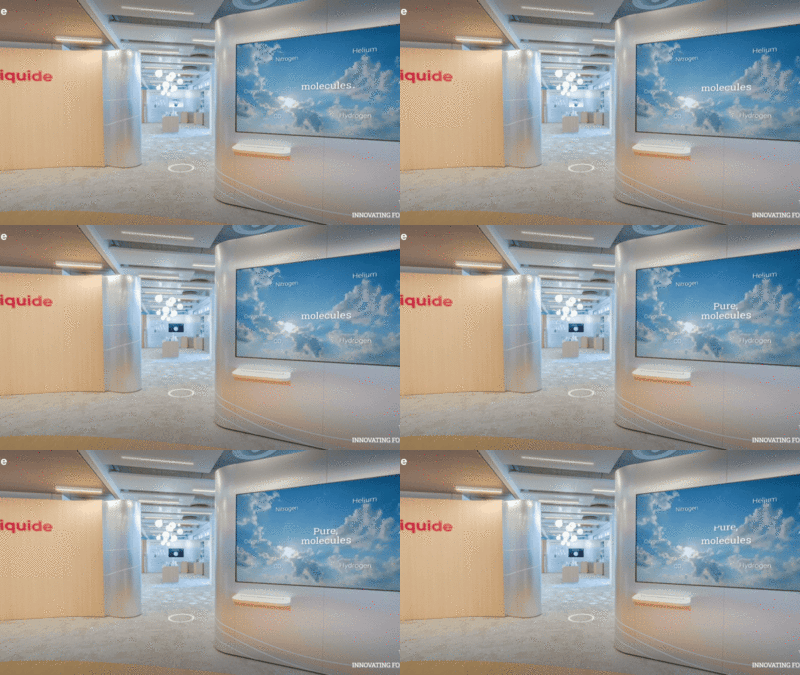
The innovation gallery
Discover the Group’s innovative applications and technologies firsthand through an interactive 3D tour.
History of innovation at Air Liquide
1902-1919
It started from innovation

Air Liquide was born of the meeting of Georges Claude, the brilliant inventor, and Paul Delorme, the wise businessman.
In 1902, after years of research and fundraising from family and friends, Claude successfully industrialized the production of oxygen from air.
International expansion

As soon as 1907, Air Liquide started operations in Japan, to meet the growing needs of the naval and railway industries for oxy-acetylene welding.
Initial public offering

Air Liquide was listed on the Paris Stock Exchange to fund its development in France and abroad.
1946-1970
Underwater exploration

A collaboration between Jacques-Yves Cousteau, Émile Gagnan, and Jean Delorme resulted in the invention of a revolutionary autonomous diving suit.
In 1946, the Spirotechnique company was founded to manufacture and commercialize this equipment.
Pipeline delivery

Air Liquide inaugurated its first oxygen pipeline in 1960 for a customer in the steel industry. Thanks to these pipelines, customers had access to large, reliable and tailored oxygen supplies.
Research hub creation

Air Liquide established its research center in Les Loges-en-Josas, later modernized in 2018 into the Innovation Campus Paris.
1979-2013
Space exploration

Air Liquide est devenu un partenaire clé du programme Ariane, fournissant des gaz industriels et des réservoirs cryogéniques destinés aux lanceurs spatiaux. Le lancement réussi d'Ariane 1 a marqué une étape décisive pour l'exploration spatiale européenne.
Global research expansion

From 1983 to 2019, Laboratories and Campuses were established in the U.S., Japan, China, and Germany to connect with leading academic and industrial ecosystems.
Supporting the electronics breakthrough

Working closely with its customers, Air Liquide developed the ALOHA™ product line, innovative precursor materials for semiconductor manufacturing.
2015-2023
CO₂ capture

Air Liquide inaugurated its first carbon capture unit in Normandy, France, leveraging its CryocapTM cryogenic technology.
Low-carbon and renewable hydrogen

Air Liquide announced the construction of Normand’Hy, a 200 MW industrial-scale hydrogen electrolyzer, to contribute to the decarbonization of industry in the Normandy region, France.