SupraMarine Project: from the lab to the ocean, the Turbo-Brayton's journey
Published on
3 minutes

Connecting offshore wind farms, located ever further from our coasts, is one of the challenges of the energy transition. How can we transport this low-carbon electricity over long distances without energy loss? A consortium of French industrial and academic partners has taken up the challenge with an innovative project: SupraMarine. At the heart of it is the exclusive Turbo-Brayton technology from Air Liquide.
The goal is to develop a power transmission system using superconductivity. An essential component of this technological breakthrough is the extreme cold required for the system to function. This is where Air Liquide's expertise comes in. The Turbo-Brayton technology was born in our labs near Grenoble, France. It has already traveled to space, sailed the seas, and is now preparing to take on offshore platforms.
The genesis of an innovation: from our labs to outer space
The story of our Turbo-Brayton technology begins at Air Liquide’s Campus Technologies in Sassenage, the cradle of our Group's deep tech innovations for more than 60 years. Developed by our teams, then manufactured in our workshops, this cryogenic solution can be summed up very simply: imagine a refrigerator capable of generating extreme cold.
The Turbo-Brayton first found its application in the most demanding environment imaginable: space. For space missions, it proved its worth by cooling critical equipment with 50 years of operation in orbit without any failures. This initial success was the first step in a long journey.
A proven technology at sea and on land

After proving itself in space, the Turbo-Brayton found a major field of application at sea. Onboard liquified natural gas (LNG) carriers, it plays a crucial role in re-liquefying the natural gas that evaporates during transport (called "boil-off"). By cooling these vapors, it prevents waste, a significant environmental and economic gain. With more than 200 units sold for this application, the Turbo-Brayton has become a benchmark in the maritime sector.

Back on land, this technology has also established itself as a key element in the production of liquid biomethane. It enables the liquefaction of biomethane from agricultural waste, turning it into a renewable fuel that is easy to store and transport.
SupraMarine: conquering the ocean
Today, the Turbo-Brayton is embarking on a new adventure. The SupraMarine pilot project aims to use High-Temperature Superconducting (HTS) cables to connect offshore wind farms. These cables can transport enormous amounts of electricity with zero resistance, and almost no losses. This requires one condition: they must be maintained at a temperature of around -200°C using very cold liquid nitrogen.
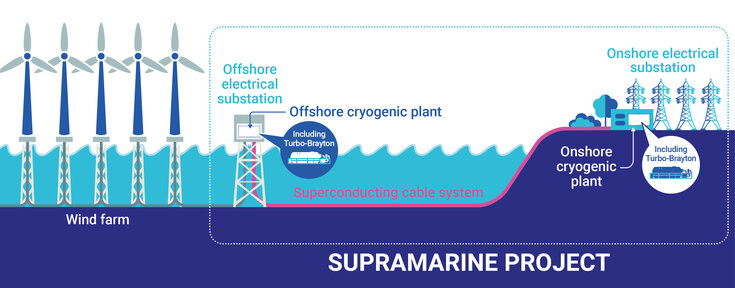
This is the critical role of our Turbo-Brayton. As part of the SupraMarine consortium, Air Liquide will provide the cryogenic plants that will act as the heart of the system, ensuring the constant cooling essential to the superconducting state of the cables.
From the initial idea in our Sassenage labs to its future integration in the ocean, the journey of the Turbo-Brayton is a perfect illustration of Air Liquide's innovation model: developing cutting-edge technologies for our customers and putting them at the service of society's greatest challenges, starting with the energy transition