Trailblazer electrolyzer
A key asset in decarbonizing German industry and mobility
In 2024, Air Liquide inaugurated a new renewable hydrogen production unit through electrolysis in Oberhausen, Germany. With a capacity of 20 MW, the Trailblazer electrolyzer, which is now connected to Air Liquide’s pipeline network, is gradually supplying hydrogen to local industrial and mobility customers.
The Trailblazer project in brief
-
Air Liquide announced its project to build a renewable hydrogen production through electrolysis in Oberhausen, with the support of the German government.
-
Inauguration of Air Liquide and Siemens Energy Gigafactory, enabling the mass production of electrolyzer components for the production of low-carbon and renewable hydrogen.
-
Air Liquide launched the Trailblazer electrolyzer in Oberhausen and connected the site directly to its existing pipeline network.

The Trailblazer electrolyzer uses PEM (Proton Exchange Membrane) technology, capable of producing up to 2,900 tonnes of hydrogen per year. This production, derived from water and renewable electricity, reduces CO₂ emissions by more than 23,000 tonnes each year.
Built from PEM modules manufactured as part of the joint venture between Air Liquide and Siemens Energy, and now integrated with Air Liquide's existing pipeline network, this site will gradually supply local industries in the Rhine and Ruhr region, one of the most industrialized basins in Europe, while supporting the development of hydrogen mobility.

The Trailblazer electrolyzer is the largest electrolyzer in Germany to be connected to an existing infrastructure. It represents a concrete response to the need to decarbonize industries, particularly the hard-to-abate sectors that are the biggest emitters and lacking in alternatives (with no possibility of electrification, for example), such as the cement, steel or chemical industries.
This project is part of a collective effort to accelerate the transition to a low-carbon industry, in partnership with Siemens Energy and with the support of the Federal Ministry of Economics and Climate Protection.
-
20 MW capacity
-
Up to 2,900 tons of hydrogen produced per year
-
More than 23,000 tonnes of CO₂ emissions avoided
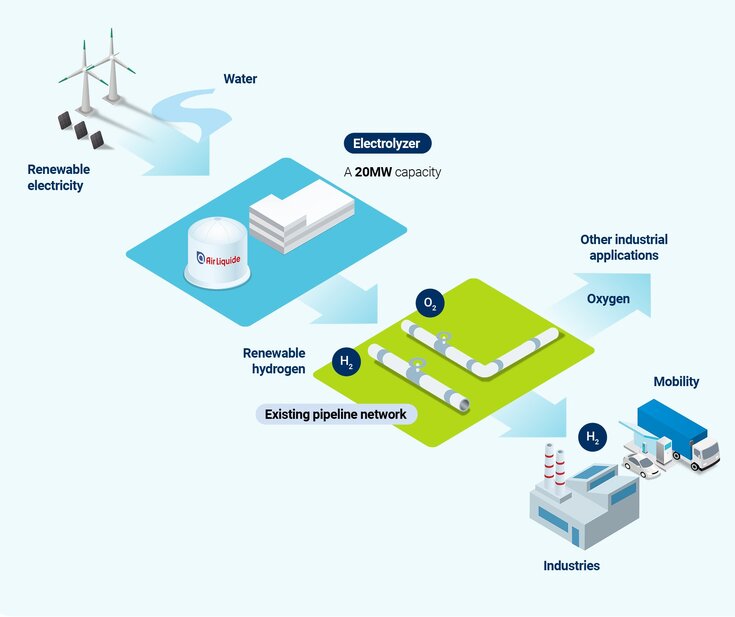
How a PEM electrolyzer works
The proton exchange membrane (PEM) electrolyzer uses electricity to split the water molecule into hydrogen and oxygen by electrolysis. This technological process takes place in an electrolyzer made up of individual PEM cells stacked one on top of the other. In each cell, a polymer membrane separates hydrogen and oxygen. When the electric current is passed through, the water molecules dissociate: the protons pass through the membrane and are transformed into hydrogen gas, while the oxygen is discharged separately. Discover how this technology works on video.
Find out more
-
Air Liquide transforms its network in Germany by connecting a large electrolyzer producing renewable hydrogenAir Liquide transforms its network in Germany by connecting a large electrolyzer producing renewable hydrogenRead more
-
The inauguration of Air Liquide and Siemens Energy Gigawatt electrolyzer factory paves the way to renewable hydrogen development at scaleThe inauguration of Air Liquide and Siemens Energy Gigawatt electrolyzer factory paves the way to renewable hydrogen development at scaleRead more
-
Renewable hydrogen: a gigafactory of electrolyzers to scale upAir Liquide is playing a leading role in the entirely new industrial and economic ecosystem needed to drive the future of hydrogen. We are partnering with major actors such as Siemens Energy.Read more
-
An electrolyzer to accelerate the decarbonization of German industryIn 2024, Air Liquide launched an electrolyzer to produce renewable hydrogen in Oberhausen, Germany. This project demonstrates the power of the collective drive to develop the hydrogen industry.Read more


