Decarbonized heavy-duty transport: Air Liquide deploys its first hydrogen trucks in the Netherlands
Published on
3 minutes
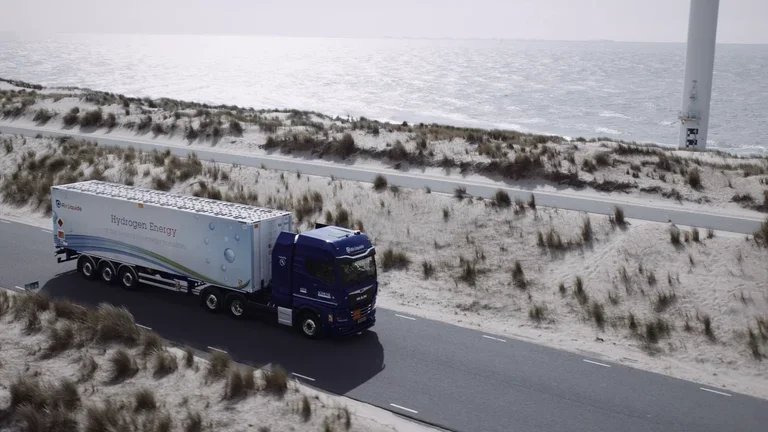
Air Liquide is taking a new step toward decarbonized logistics by putting its first two hydrogen-powered trucks into service in the Netherlands. Conducted in partnership with transport company Schenk, this pilot initiative aligns with a shared objective to reach carbon neutrality by 2050.
The deployment of these vehicles fulfills a strategic mission: delivering hydrogen to supply stations across the region of Rotterdam, while paving the way for the future of more sustainable heavy-duty transport. It is a highly coherent approach, as highlighted by Axelle Albot, Project Manager at Air Liquide: "We are not only providing solutions to decarbonize industry and mobility, but we are also using those very same solutions to decarbonize our own supply chain."
Power and payload: Hydrogen hits the road
Integrating these vehicles delivers a technical solution perfectly calibrated for the constraints of freight transport. Maintaining operational standards was a strict prerequisite: these trucks are certified for the transport of hazardous materials, guaranteeing a level of safety and reliability rigorously identical to that of traditional diesel fleets for this type of activity. As Matthijs Cools, Transport Category Manager at Air Liquide, explains, this choice offers "the best of both worlds by combining a proven engine technology with a carbon-free fuel." Furthermore, this energy source provides a decisive logistical advantage, as explained by Hans Mulder, Technology and Procurement Director at Schenk: "The vehicles have a lower weight compared to the battery-powered vehicles. That helps us a lot in increasing the payload." Refueling times are also considerably reduced. On the road, the transition is proving to be seamless: according to Sophie Blanchart, a driver at Schenk, "You can feel the power, but the driving remains very light and smooth, even with a heavy trailer. The truck responds very well, maneuvering is simple, and the range is remarkable. It offers a much cleaner and more serene working comfort on a daily basis!"
Vehicles and stations: A joint deployment supported by the authorities
Operating this fleet relies on the simultaneous adaptation of the refueling network, operated by TEAL Mobility, a joint-venture between TotalEnergies and Air Liquide and a key infrastructure partner in the project. The Roosendaal station, ideally located along the key corridor connecting the Netherlands and Belgium, has been equipped to supply these heavy-duty trucks at a pressure of 700 bar. To synchronize the arrival of the vehicles with the upgrading of the stations, the ecosystem benefited from the SWiM (Subsidy for hydrogen in mobility) program. Supported by the Dutch government, this framework helps overcome the chicken-and-egg dilemma: its purpose is to co-finance both the trucks acquisition and the investment in the stations.
The next steps build on this complementarity: if the testing phase conducted until the end of the year is successful, Air Liquide plans to deploy additional trucks next year to progressively decarbonize the hydrogen supply chain across the Benelux region. In parallel, TEAL Mobility is continuing to expand the distribution network, with new station openings planned near the major logistical hubs of Rotterdam and Antwerp.